the true voice of wood

In an earlier post I discussed how I’d travelled to Texas a couple of years ago in search of my perfect acoustic guitar, but became intrigued by ‘strummable dulcimers’ in the process after meeting Kevin Jones of the Olympia Dulcimer Company (ODC) at Hill Country Guitars.  I was so impressed by Kevin’s beautiful handmade instruments that I hoped that someday I may be able to add one of his walkabout dulcimers to my collection.

Back in April I treated myself to a Seagull Merlin dulcimer and was immediately enchanted by its wonderful folksy/bluegrass tone.  I can imagine I will get years of enjoyment out of it and look forward to taking it camping and letting the kids hammer away on it.  It is a perfect introduction to the seductive tone of the strummable dulcimer, but it also made me want to get a ‘proper instrument’ like the ones from ODC.  As luck would have it I found a few dollars tucked down the back of the sofa and decided it was time to reconnect with Kevin.

After scoping his website and Facebook page; watching dozens of videos; as well as researching similar/competitive products, I decided that Kevin’s instruments are indeed quite unique and beautifully handcrafted.  The challenge was going to be figuring out which style to choose – standard or bass; diatonic or chromatic; 3 double courses of strings or 4 (i.e., 6 strings or 8); and which design, woods and more?  It’s a lot to consider and they all have their benefits and all sound beautiful.  Clearly a conversation with the man himself was in order…

Kevin and I chatted briefly on April 10th and he agreed to ring me up on the weekend from his shop, so we could have a proper conversation.  True to his word we connected that Sunday afternoon, which also happened to be my birthday. After discussing the relative merits of standard versus bass walkabout dulcimers and diatonic versus chromatic and all of the other esoteric details I decided that a standard sized 6 string diatonic instrument would be the one for me.  My thinking being that the standard diatonic instrument has the true voice of an original mountain dulcimer.  While I love the sound of the 8 string bass dulcimer I find it is getting much closer in sound to an acoustic guitar in an open tuning or an Irish Bouzouki than the unique tone of a dulcimer.  The choice between diatonic and chromatic was much harder.  While the chromatic instrument will give you the flexibility to play in any key with all the minor notes as opposed to the open D tuning of the diatonic instrument (i.e., D-A-D); you can only achieve that pure dulcimer sound with just the whole notes of the diatonic style.  In particular, this makes a big difference when sliding up and down the fretboard and it really contributes to the traditional tone and feel of the instrument.  Thus, after much hemming and hawing the diatonic choice was clenched for me when my 6-year-old daughter told me I just had to get the one tuned DAD!   🙂

Now with the style and layout decided it was time to discuss tonewoods…

The choice of wood for an acoustic instrument is a highly subjective one and often highly contentious too.  My Collings SJ acoustic is the classic Rosewood/Spruce combo which has been one of the go to combos of discerning players and luthiers for decades.   I am definitely amongst the throngs of players who love the deep warmth and loud tone of a true rosewood instrument and I feel it works particularly well on an instrument with a big box like the SJ.  In many ways, body tonewood is split into a few camps of rosewood, maple, and mahogany with most, if not all, types of woods falling into being described as ‘somewhere in-between’ any two of these woods.  To my ears, I find many maple guitars too bright, but there are exceptions and the type of maple (e.g., big leaf vs. curly vs. hard rock, etc.) and the construction and age of the instrument can impart a unique flavour and help balance the tone.  Inversely, mahogany sounds dull, subdued, and uninteresting to me, although I’ve heard it said it ages well and that its tone evolves.  It is certainly true that as the wood in a guitar ages and is opened up by the resonance of being played that they can take years to find their true voice.

As my ODC dulcimer was being made to order having the opportunity to discuss this sort of detail with the maker directly was fascinating.  Kevin is a one-man show making his instruments by hand and as a result there isn’t really an abundance of his instruments available for me to try locally and flying to Texas to test drive one wasn’t feasible.  I had to rely on Kevin’s expert knowledge of his instruments and what worked best for them along with lots and lots of YouTube demos.

While visions of Brazilian Rosewood or Cocobolo flashed through my mind, sourcing exotic woods like these can be extremely challenging due to limited supplies and/or protective measures in place due to scarcity and environmental concerns*; which also equates to more cost. Kevin was extremely accommodating and offered to try to get me any wood I desired; however, after discussing the woods he had on-hand the one that stood out to me was Myrtlewood.  Native to Northern California and the Pacific Northwest; Myrtlewood intrigued me and seemed a fitting choice for an instrument being crafted by a company with strong ties to that part of the continent having started near Seatle over 20 years ago.
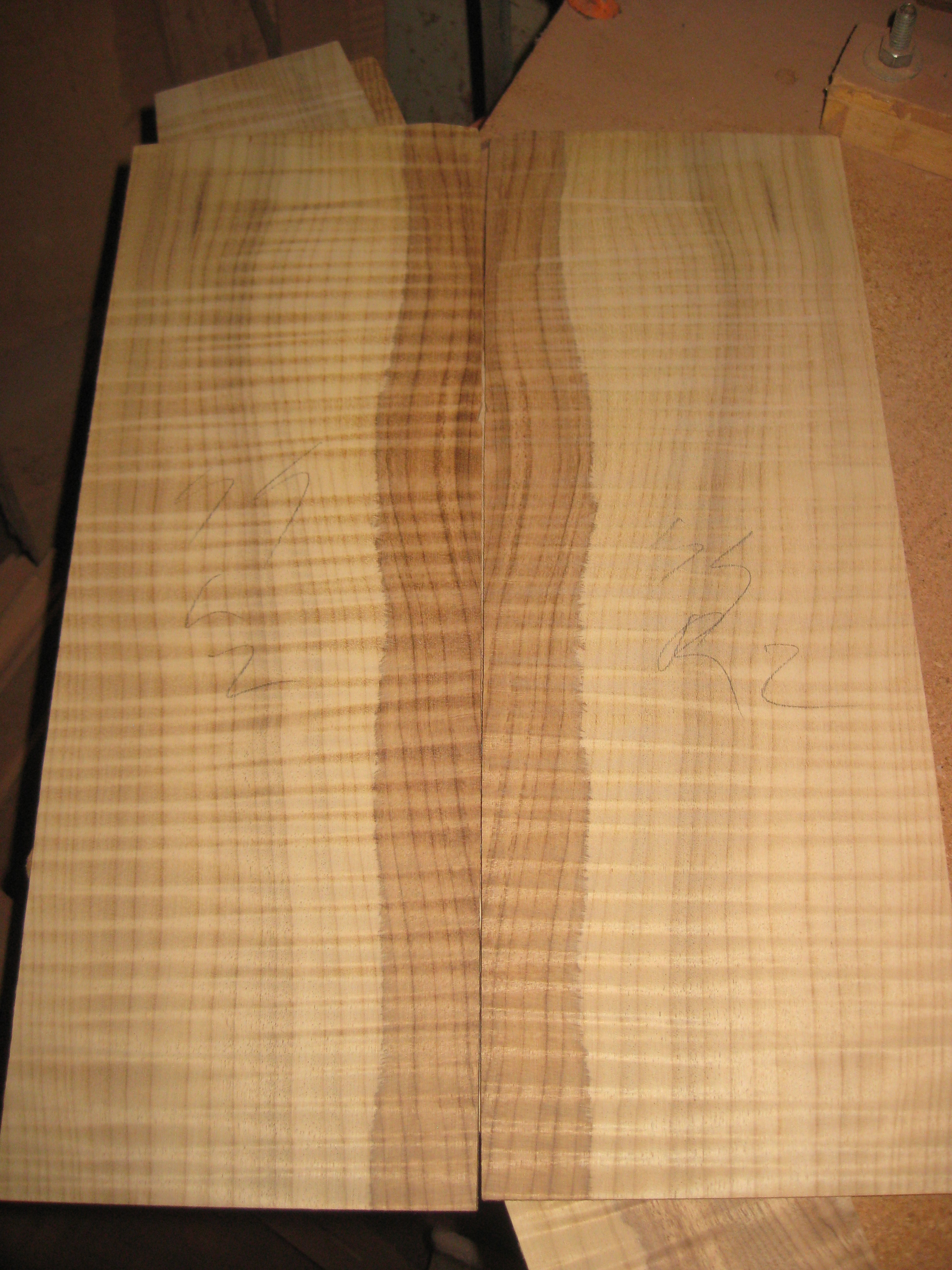
Marvellous Myrtlewood

A gorgeous piece of Pacific NW Myrtlewood for the back and sides of my walkabout dulcimer.
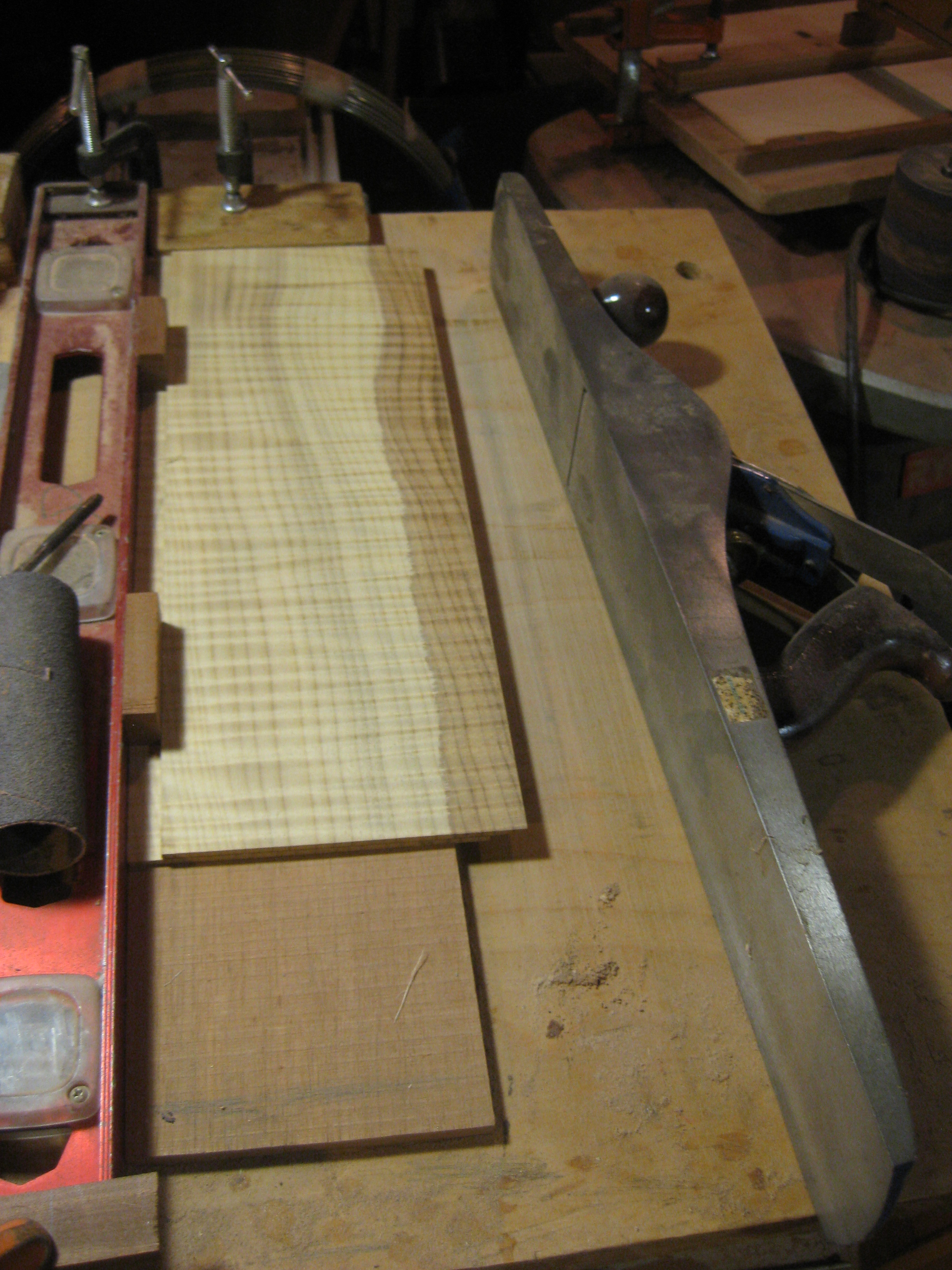
Jointer plane

Hand planing the mytlewood for the back.

Myrtlewood is a fairly unique and unusual tonewood despite it being a North American native species.  It was also a wood I had considered before.  When I started looking in earnest for a new acoustic guitar a few years ago there was a beautiful looking (and sounding!) Breedlove instrument in myrtlewood, called the Northwest Classic, that was very much on my short list.  However, I’m not really a fan of the Breedlove bridge design and may have struggled with the look of the instrument.  As much as I liked the Haida inlays on the fingerboard it was perhaps a bit more ‘bling’ than I generally like on an acoustic.  I know these things shouldn’t really be a factor and it’s only the sound and playability that matters in the end, but vain though it may be they still put me off a bit.  That said, all the positive reviews for the myrtlewood on that Breedlove guitar and others plus Kevin’s recommendation sold me on going with Myrtlewood back and sides on my walkabout dulcimer.

SItka Top

This lovely piece of beautifully figured sitka spruce will be used for the top of my instrument in a unique ‘teardrop’ shape.
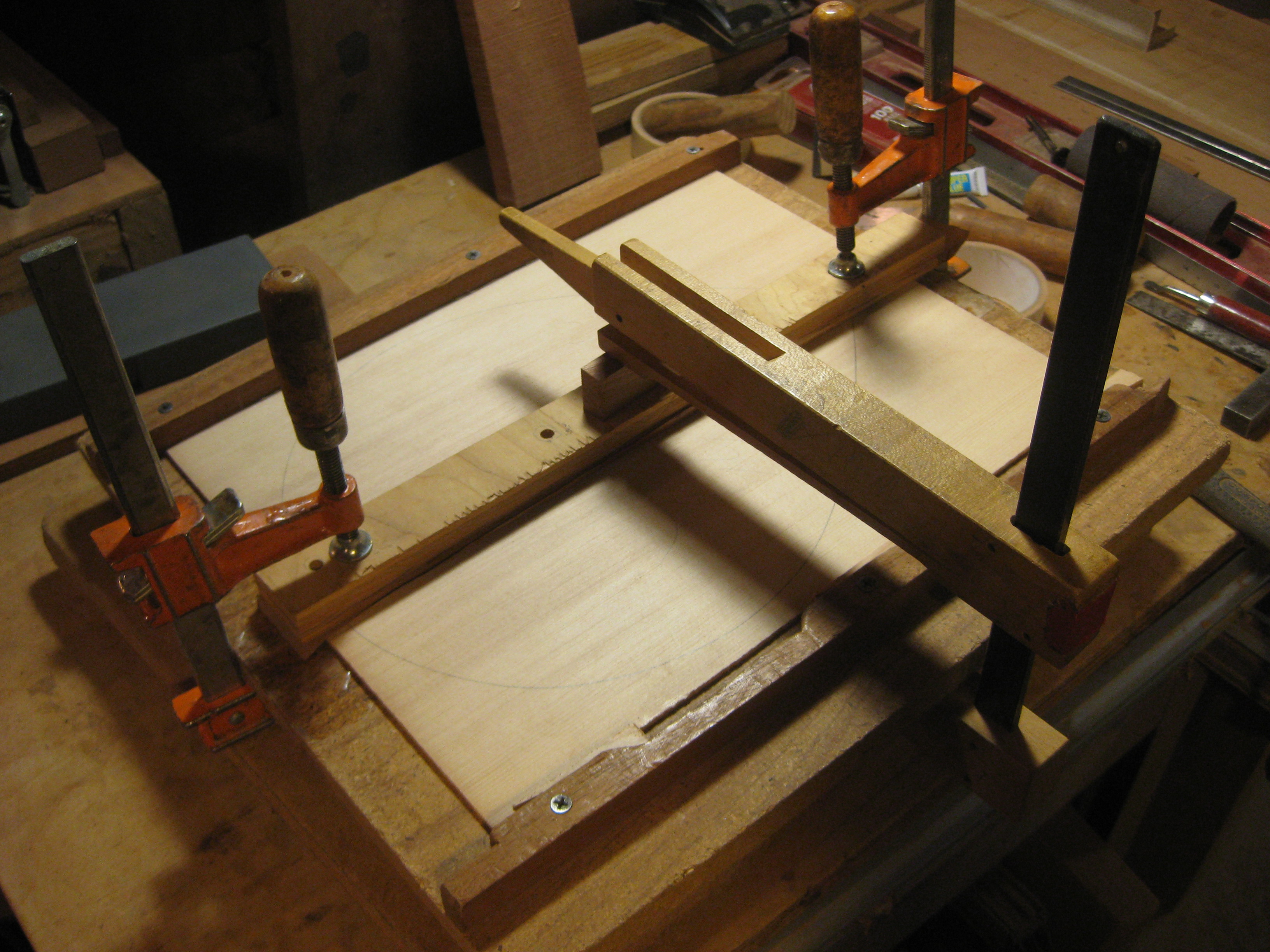
Spruce Top glue-up

Gluing up the sitka spruce top.

ODC primarily use sitka spruce tops since it is noted for its exceptional strength and tone.  This is a choice I fully support, while other soundboard woods such as cedar have their place on classical guitars or other more exotic woods like Koa or Redwood can impart a unique sound, the classic spruce soundboard is just that for a reason.  There is a ton of information online dedicated to the often hotly debated and admittedly nerdy topic of tonewood and soundboard wood.  However, if it’s of interest it is worth seeking out.

neck blank

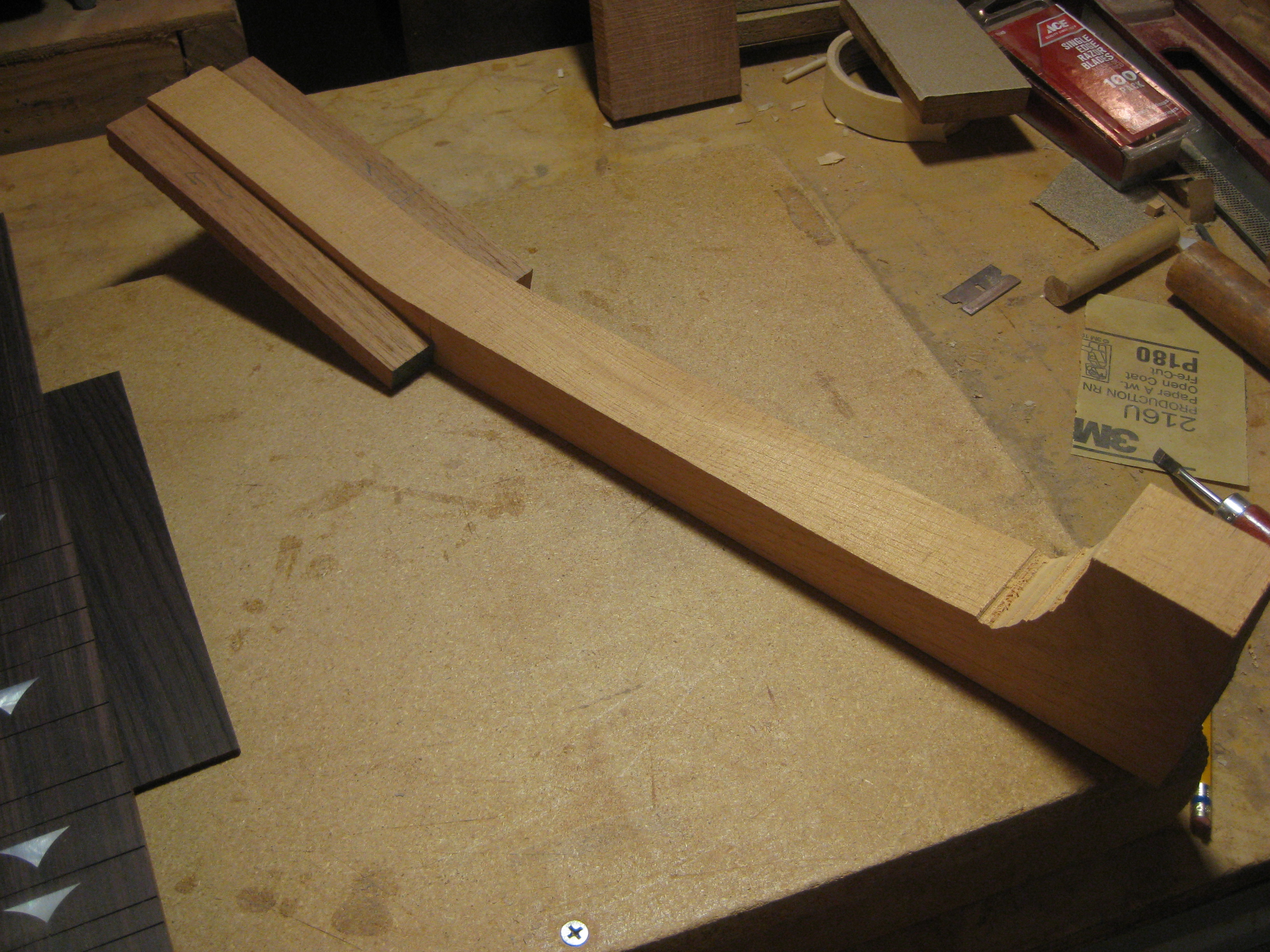
Spanish cedar neck blank rough cut on the workbench at ODC.
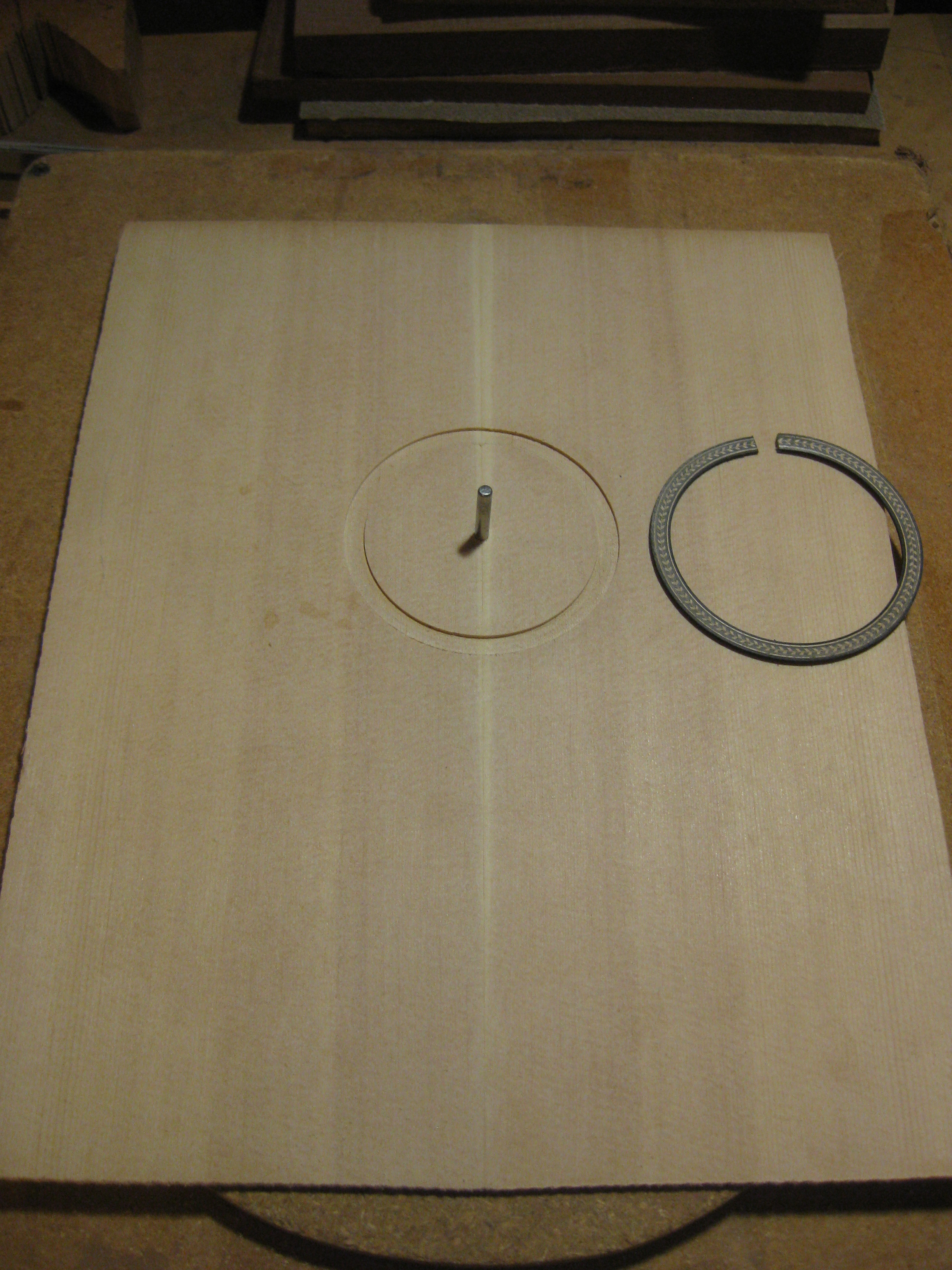
Preparing to glue the rosette to the soundboard.

Preparing to glue the rosette to the soundboard.

Next came the decision for the neck and fingerboard.  Again there is a lot of discussion out there about various neck woods and fingerboards and it does come down to personal preference and availability.

For my ODC dulcimer it really boiled down to two – Spanish cedar or Honduran Mahogany.  In many ways these two woods are quite similar; however, in discussing with Kevin I felt the cedar might be the better way to go as it is quite a bit lighter than the mahogany and should hopefully make the instrument feel more balanced and light while providing a good strong neck.

The fingerboard was an easy choice for me – I definitely prefer rosewood fingerboards in almost all situations and most of my instruments are similarly equipped.  The bridge will also be made of rosewood with a bone saddle and nut.  The ODC diatonic dulcimers feature a cool looking ‘evolving’ triangle inlay in mother of pearl; which, to my delight, I learned was influenced by the classic BC Rich shredder guitars that seemingly every hair band in the ’80s had.  This is Kevin’s way of paying homage to where he started working building these very guitars at BC Rich back in the day.
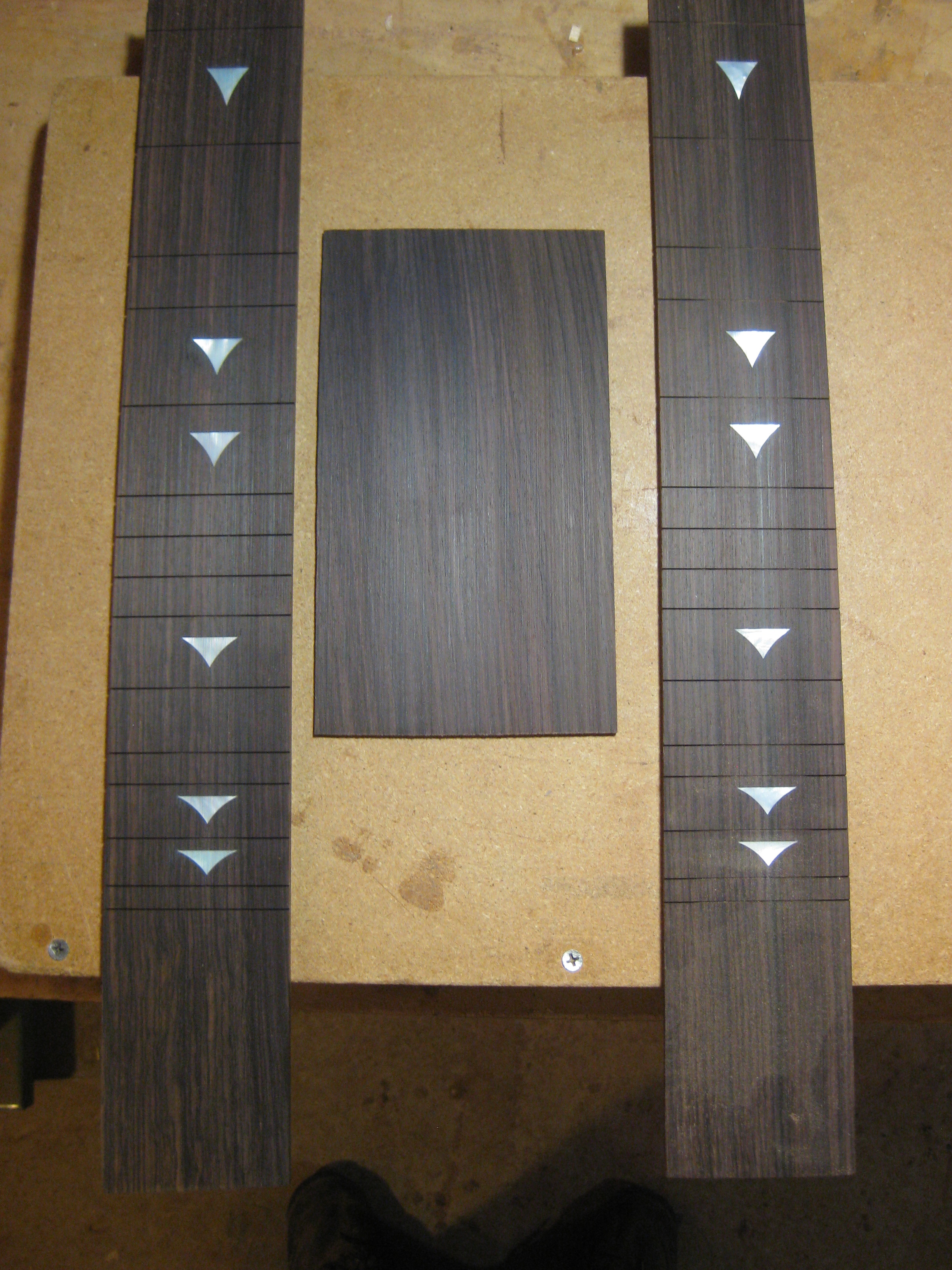
Rosewood

The rosewood fingerboard on the right will be on the neck of my dulcimer. The piece in the centre is the rosewood laminate for the headstock.

In the photo to the right you can see the piece of rosewood that will be used to laminate the headstock. Typically the ODC Signature series instruments have O-D-C in mother of pearl inlay on the headstock.  I decided I want to do something different and asked Kevin if I could get a custom inlay of my design put on the headstock instead.  Ever accommodating he agreed and I set to the task of finding and designing the right symbol.

I decided I wanted to do a stylised version of a trillium – the beautiful, wild, 3-pointed provincial flower of Ontario – to represent where I live and the 3 courses of strings on a dulcimer.  After trying various different designs I finally decided that a celtic knot representation of a trillium would be fitting given my British/Gaelic roots.  The final twist was to do a mirror image of the trillium knot to echo the double course of 3 strings on a strummable dulcimer and that I felt it looked awesome too.  I have already, not surprisingly, dubbed my dulcimer “The Trillium” in anticipation of its arrival!  A name that will stick with it for as long as it is in my possession and hopefully beyond.  More to come as the build progresses and The Trillium arrives in 6 weeks or so…
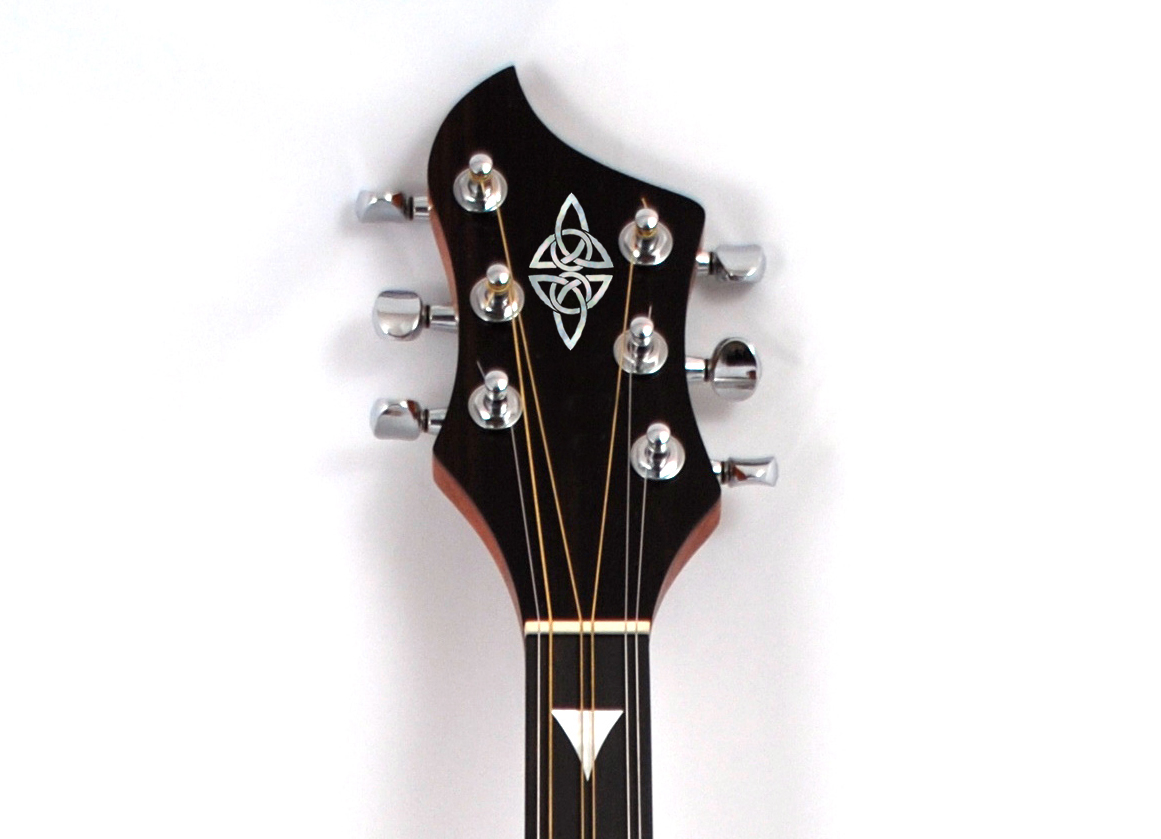
The Trillium

I did a mocked-up version of what the final mother of pearl Trillium celtic knot inlay will look like.

* note: there are ~3 million acoustic and electric guitars manufactured in the US each year.  It takes approximately 120-150 spruce logs to fill this demand.  To put that into perspective, a single sawmill can turn 120 logs into 2 x 4s in a single shift.  Thus, the impact of instrument manufacturing is negligible compared to the thousands of trees being clearcut for home building domestically and in Asia.  You can read more about the use of wood in instruments in this enlightening article: “The Troubling Truth About Sitka Spruce” (Guitar Player Magazine – June 2007)

discovering the dulcimer’s sweet song

I heard awhile ago about an amazing new instrument that is essentially a relatively new class of instrument called a “strummable dulcimer”.  I’d always been intrigued by dulcimers, but also confused by the various types.  Did you play them with a feather quill?  Or hit them with little hammers…or is it a bow?  Are there electric dulcimers?  It turns out all of the above is true, but that the types of dulcimers are as varied as the cultures and music they have evolved from.  Further compounding a true definition of what a dulcimer is are the various instruments that seem to fit into the same category such as the octave mandolin, the zither, the bouzouki, the Irish bouzouki, the balalaika and more.  It started to seem that anything that was a stringed instrument and wasn’t a guitar, sitar, mandolin, ukulele, banjo or anything in the violin family might just be a dulcimer!

Further research seemed to narrow things down somewhat, but has yet to really provide me with a good answer as to why so many seemingly disparate instruments have the name dulcimer.  If I had to categorise them it would seem there is the traditional “hammered” dulcimer that originated in many parts of the world particularly Asia, the Middle East and Eastern Europe.  It is a trapezoidal shaped instrument that is very much like a harp that you lie flat on a table and has numerous strings that are quite literally hammered in a percussive manner.  They can really sound incredible in the right hands.

Then comes the Appalachian or Mountain Dulcimer.  This is what I had traditionally thought of as a dulcimer; however, other than knowing that Joni Mitchell made its sound famous on A Case of You I can’t think of many examples of one being used in popular recordings.  I had thought one of my guitar heroes, the late Rory Gallagher, may have employed an electric dulcimer on a couple of tracks too in the 70s or 80s, but I don’t see one in his online instrument archive and I wonder now if it may have been this awesome looking electric sitar instead.  I know he used that really effectively on a track called Philby in the mid 80s.  It seems the mountain dulcimer and its bowed variant, as demonstrated here by a man with large glasses and an even larger mustache have mostly languished in obscurity or at least coffee shops.  Despite that, it is certainly a unique instrument with its diatonic scale and only three courses of strings.  These features make the mountain dulcimer both easily accessible for beginners and nearly impossible to coax a bad note or chord out of.  However, its unconventional look and unique playing position of sitting it in your lap, or like a cello in the case of the bowed dulcimer, likely make it a niche instrument.

MySeagullMerlin

My Merlin

Which brings me back to my original point about the new instrument class being referred to as “strummable” dulcimers. It seems the concept of a strummable dulcimer or “dulcitar” was developed in the early 1970s by a luthier named Homer Ledford.  He later went on to trademark the name and other makers developed their own variations such as the Strumstick or the Pickin’ Stick.  Although, other than seeing the occasional barefoot hippie wandering about with one of these over their shoulder with a rope for a strap I’d not really given the instrument any real attention and wrote them off as patchouli scented toys and certainly not dulcimers.  That was until I heard about a Canadian Luthier named Robert Godin, who already made very nice and affordable acoustic and electric guitars under the Seagull, Norman, Simon & Patrick and Godin brand names, launching his own line of strummable dulcimer called the Merlin.  These caught my attention because even though they only had 7 frets (i.e., one scale of 8 whole notes) they looked like a quality instrument with a more substantial soundboard and were very much modelled after the mountain dulcimer with 3 courses of strings but the top D strings were doubled and the whole thing oriented to a guitar player.  I had to have one and at a $129 why not!  Perfect to take camping or to a backyard campfire sing-a-long…

After being aware of the Merlin since late last year I decided to treat myself to one for my birthday earlier this month.  I whipped down to my local guitar shop and picked up a mahogany Merlin preferring the tone and look to the spruce version.  Not a day has gone by since I got it that I’ve not picked it up.  Given its size and weight it is easy to just leave out at arms length and grab whenever the mood strikes to bang out a couple little ditties for a few minutes before getting on with your day.  It has also recharged me creatively and got me composing some interesting music for the first time in quite some time.  The wonderful simplicity and pure wood folksy tone of the Merlin is charming and everyone I have played it for just loves it.  Here are a couple samples of tracks I recorded on my phone.  A bit of double tracking and messed around a bit with some overdrive effects, but 100% Merlin.  Certainly nothing fancy, lots of background noise, no editing and single takes, but lots of fun!

BONUS: the word dulcimer is derived from the Latin dulcis (sweet) and Greek melos (song).  I couldn’t agree more!

the beginning of something beautiful!

In March of 2013 I travelled to the SXSW Music, Movies and Interactive conference and festival in Austin, TX.  Having been fortunate to have attended many times in the past this time I was planning a little something special…

I had been thinking for some time that I would love to find my perfect acoustic guitar and prior to going to SXSW I had been doing a great deal of research about the best, handmade instruments.  For a number of reasons Collings Guitars were topping my list after dismissing the big manufacturers like Gibson, Martin and Taylor for various reasons.  Instead the small to mid-sized boutique makers like BourgeoisSanta CruzBreedlove, Froggy BottomLarivee along with Collings were where I had been focussing my research and attention mainly because I wanted a properly sourced, handmade instrument from a luthier that produced consistently great products like any of these shops do.  Unfortunately, living where I do in Southwestern Ontario finding somewhere to try any of these instruments requires substantial time and effort. Now that I was in Austin I decided to contact Collings and see if I could get a tour of their shop and see where the magic happens.  They agreed and everything was arranged for that Friday morning.

Collings Guitars

Collings Guitars, Austin Texas

It was a fantastic tour and I learnt a ton about how they build such amazing guitars and mandolins by hand.  I even had an opportunity to briefly meet the man himself – Bill Collings.  However, this is not the purpose of this post, so I will save the rest of this story and all the photos from my tour for another day and another blog entry.  Instead, I want to talk about what happened after my tour.

Collings Guitars

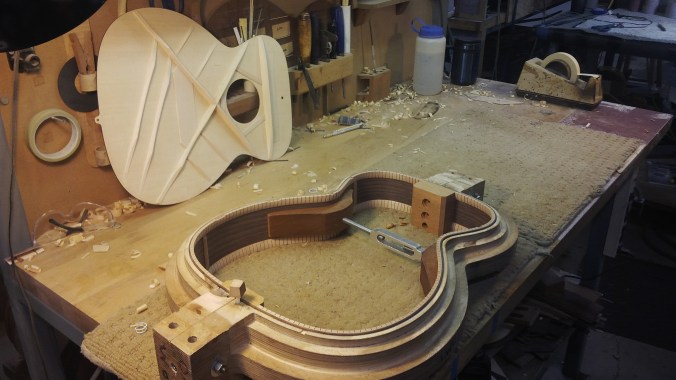
Work bench in the Collings shop with the parts for (what I believe to be) a rosewood/spruce OM1 are waiting to be assembled while the body is glued together

Having seen how beautiful, hand-crafted guitars like Collings are made I was now itching to get to try some.  In deference to their dealers Collings won’t let you buy a guitar from them directly instead referring you to one of their dealers’ stores.  The closest and highly recommended dealer was the Hill Country Guitar shop in Wimberley TX now (sadly) relocated to Austin.  I decided I must make my way there at once!

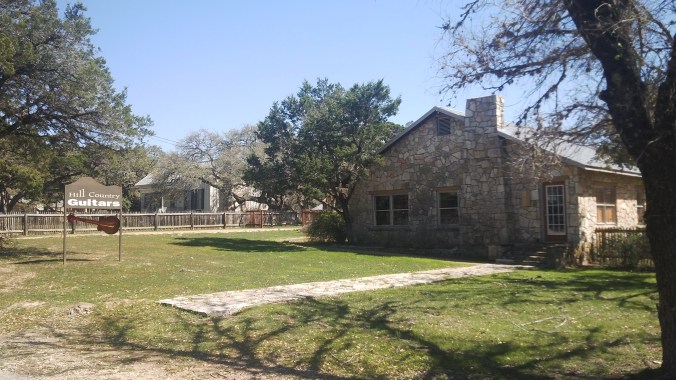
After a sandwich and a short drive through the beautiful Hill Country region I arrived in Wimberley.  I marched around the small village of Wimberley trying in vain to find this elusive guitar shop.  After asking directions twice I finally realized that it must be the old stone building in the field back behind the main street.  Indeed it was and what a fabulous guitar shop!  The whole vibe of the place was perfect and the massive collection of gorgeous guitars immediately blew me away!  It smelled great too – I truly love the smell of wood, especially from fine instruments.  There had to be 40+ Collings in the main room and a couple more large rooms filled with amazing instruments – this was going to be great!

Hill Country Guitars

Hill Country Guitars – Wimberley TX. March 2013

I was warmly welcomed by Kevin Jones and invited to try as many guitars as I would like.  I immediately spied a beautiful Collings SJ Indian Rosewood/Sitka Spruce guitar and found a comfortable place to sit and try it out.  It was love at first chord.  I couldn’t believe the feel and tone of this instrument.  And it was within a price point that fit my budget – not that I’d really set one (dangerous!).

After playing the SJ for awhile I started to try out numerous other guitars, but the SJ was really sticking with me.  There were a couple other Collings and a Froggy Bottom that sounded and felt great too, but with price tags approaching that of a small car those had to be ruled out right away.  While on this adventure in tone many hours passed and I had an opportunity to speak with Kevin on and off throughout the afternoon as well as a few other folks who had been on the Collings tour with me that morning.  Kevin was very complimentary about my playing style and he and some of the other customers likened it to Nick Drake.  Higher praise I cannot think of and these guitars and the feel of that place on a warm spring afternoon in Texas was definitely helping me channel my inner folkie.

In speaking with Kevin I learnt that he had been building ‘walkabout’ dulcimers in upstate Washington for many years as the Olympia Dulcimer Company and continued to build them from his shop in Wimberley.  In fact, several of his instruments were hanging above the fireplace in the shop near the door.

Collings SJ

My beautiful Collings SJ Indian with SOLD sign!

I went over and admired them and wondered what they would sound like.  However, since I was on a mission to find my perfect acoustic guitar I didn’t want to be distracted from my goal.  I tried several more beautiful guitars including some gorgeous ones from a local luthier named John Allison.  In fact, as I narrowed the field on my favourites, one of the Allison’s became a strong contender.  As it turned out a local musician came in and asked me to demo that very Allison for him and he decided to buy it after ruling out a Martin and a Santa Cruz!  It now seemed obvious that the very first instrument I tried – the Collings SJ Indian was going to be making the long journey north to Canada to join me there after I returned home.

It was now well past closing time, and myself and the gentlemen who purchased the Allison were busily finishing up our transactions.  Kevin and shop owner Dwayne were very patient and assured me my new SJ would be safely packaged and carefully shipped by ground to my home first thing Monday.  Satisfied that everything was in order I went to leave that magical shop in the fields of Wimberley TX.  And as I went through the aluminum screen-door, with it’s guitar motif, I looked up at Kevin’s ODC dulcimers and regretted not trying them after all, but was determined to learn more about what a walkabout dulcimer is and maybe someday add one to my collection.